


Shaping passions
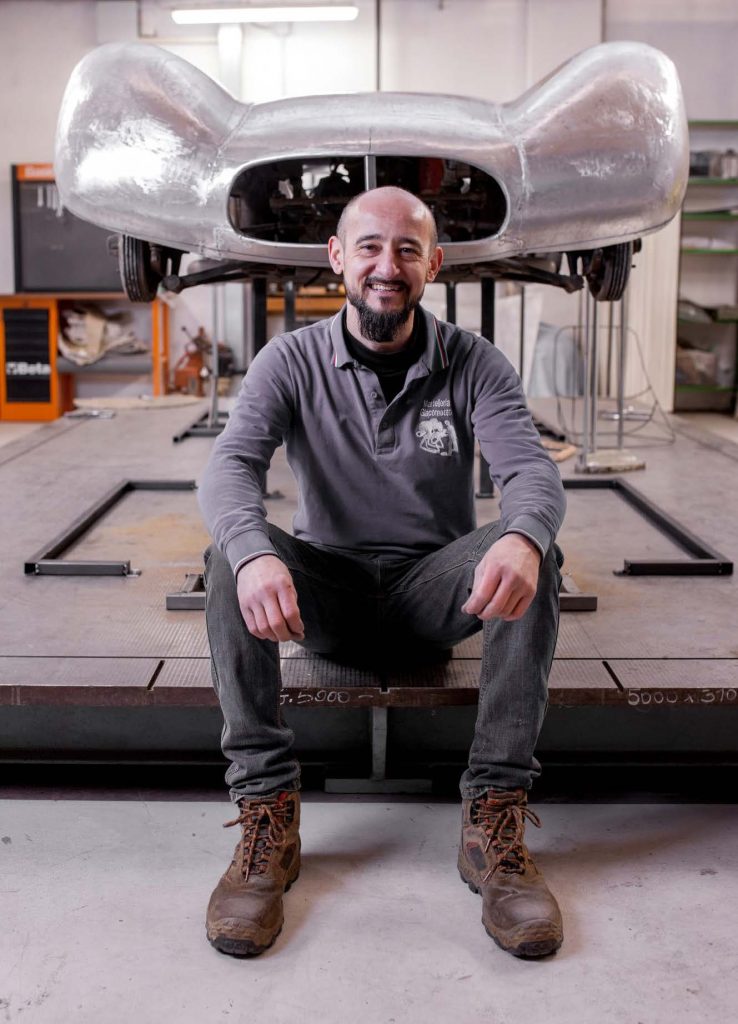
I’ve been into craftwork since I was a kid: making something with my hands has always given me great satisfaction.
I was lucky enough to live with my grandfather who was able to build and fix almost anything. He showed me how to use various tools, while my father, a watchmaker and goldsmith, taught me to pay attention to the smaller details and to appreciate beauty.
So, after fifteen years spent managing my family shop, restoring mechanical watches, and repairing gold jewelry, I turned my life around and started to work with different metals, cheaper than gold but just as precious.
Thanks to Mario, a master in metalshaping with many years of experience at Pininfarina body shop, I learnt.
The foundations of my new profession, and above all, have given me the passion for bodywork panel beating.
Already... the passion...
Living in the province of Turin has its advantages for those who do my job.
In no other place in the world has there ever been such a high concentration of builders of special coachworks. This is thanks especially to Fiat which, even after the 1930s, continued to supply bodies with mechanics to those who enjoyed designing and building “special” cars.
Even today, the style and construction of prototypes for numerous world-famous automotive houses pass through Turin.
In 2019 I realized the dream of having my own workshop where I could work to best satisfy the demands of clients and cultivate my passions.
Since then I have learned to do a bit of everything.
From making molds with resins to reproduce bodywork models, to sheet metal welding with various methods: from the “old” oxy-acetylene flame to the more modern TIG on both steel and aluminum.
I have learned to create beaten pieces by hand alone with hammers and anvils or with the help of the Eckold (a sheet metal forming machine) and to assemble and mount entire vehicles both in the field of restoration and prototypes.
My future?
To continue creating shapes with sheet metal, not only in the automotive sector but also in the service of art or home furnishings.
To collaborate and put myself at the service of those who have interesting and stimulating projects, to continue learning and improving in my work.
Coachbuilding in Piedmont
On the eve of the First World War, between Turin and Milan, around fifty coachbuilding firms emerged; just as many appeared in the period between the two wars (Stabilimenti farina a Castagna, Balbo, Touring, Allemano, Vignale, Zagato, Francis Lombardi, Fissore, Garavini, Savio, Boneschi, BoanoA further twenty-five were founded from the post-war period up to the 1960s (while many important foreign coachbuilders ceased operations after the 1950s). Today, there are names famous all over the world (Italdesign, Pininfarina and Ghia to mention just a few) that inspire and influence major automotive design worldwide.
1
Art and Craftsmanship
Can an automobile be defined as a work of art?
In Renaissance Florence, a fertile cultural “humus” developed for painters and sculptors made up of art workshops where masters trained apprentices and pupils who were in turn destined to become great artists. This was the case in fact for Botticelli, al Perugino, al Ghirlandaioand himself Leonardoall of whom grew up in the workshop of Andrea del Verrocchio..
2
Tradition / Innovation
Starting from “stile” models and/or stamping models, there has been an interesting evolution in recent decades in favor of a better final result for the details made by hand.
The first artisanal coachworks, made from drawings, were realized on “filoni,” 1:1 scale forms handcrafted by the technicians who reproduced the volumes of the car with iron rods, or alternatively by carpenters who built the wooden “mascheroni” in sections.
3